Group-mind
Last and First MenGroup-mind is the distinct, higher-order consciousness formed when the specialized brains of a ninety-six-member sexual group operate together as a single electro-magnetic system. Its significance lies in the difference between communication and shared being: individuals can exchange experience telepathically, but only their coordinated awakening produces a new mind, with its own range of perception and insight. The account presents this collective consciousness as an achievement of species design, a way to exceed the limits of an individual brain without simply enlarging it.
Design and Biological Basis
The designers of the species sought a mentality beyond their own, but understood that an individual human brain could not safely exceed a certain weight. Their solution was to distribute the necessary organization across several specialized brains and unite them through ethereal radiation. A brain could then function, on particular occasions, as a node in a larger system whose physical basis was the organized network itself.
Telepathic communication between individuals had existed before, but it had not produced a super-individual or group-mind. The account identifies the racial mind of Martian individuals as a precedent that failed to transcend its members. To avoid that failure, the designers made a small multi-sexual group the basis of the new unity. Sexual intercourse is not itself the cause of group consciousness. Rather, the social intimacy of the group helps foster temperamental harmony and complementarity, conditions described as necessary for higher experience.
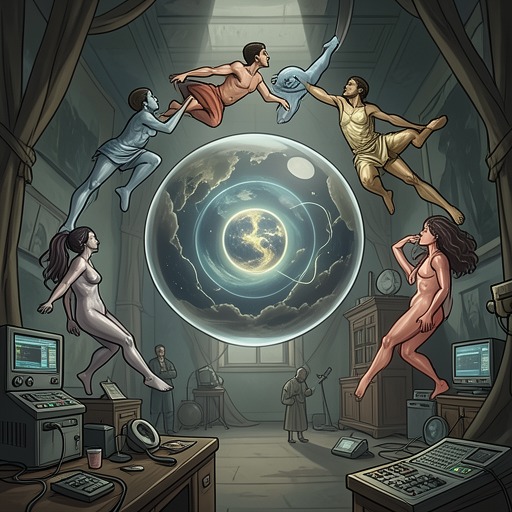
Each member has a specialized organ in the brain. Useless in isolation, these organs cooperate telepathically to form the group’s single electro-magnetic system. Each sub-sex has an organ with its own form and function, and unified mental life depends on the simultaneous activity of all ninety-six. This apparatus does more than let members share what they already experience: the group-mind has an experiential range beyond that of any member alone.
Temperament and Collective Awakening
The specialized organs work in conjunction with differences in temperament and capacity among the sub-sexes. The narrator offers familiar psychological types among the First human species—such as meditative, active, mystical, intellectual, artistic, theoretical, concrete, placid, and highly strung—as a limited analogy. The sub-sexes differ in comparable but much greater variety. Those differences are not treated as noise to be eliminated; they enrich the collective self, giving it a range that the First human species could not have attained through telepathy and electro-magnetic unity alone.
For ordinary business, each member remains a distinct individual, and telepathic communication is the usual means of communicating with others. Group-mind exists only in episodes of collective awakening: its being consists in the individuals comprehended together, not in a separate entity that persists independently of them. When the awakening occurs, every member experiences every body in the group as part of a multiple body and perceives the world from all those bodies. All members awaken at the same time, so the expansion is simultaneous rather than a succession of private viewpoints.
That widened field of perception is only the beginning. The collective state also makes possible kinds of experience unavailable to isolated individuals, including insight into unsuspected features of the familiar world. The narrator cannot describe those experiences in detail, but stresses that the difference between ordinary and group mentality is more radical than the difference between an infant mind and an adult mind. In this higher mode, most—but not all—of the enduring philosophical puzzles, especially those concerning personality, can be restated with such clarity that they cease to be puzzles.
Social Organization and Return to Individual Life
Groups encounter one another on this higher plane as super-individuals. Together they form a community of minded communities: each group is a person, distinct from other groups in character and experience much as one individual differs from another. The collective order therefore does not erase difference at every level. It makes a new level of social relation possible between groups that have their own modes of insight and appreciation.
Occupations, however, are assigned to individuals, not to whole groups. A group is not set apart as an industrial, astronomical, or otherwise single-purpose unit; its members may pursue many professions. The group’s function is instead a particular manner of insight and appreciation, which guides the work of its members. That guidance continues beyond the episode of shared consciousness. When members return to limited individual experience, they cannot retain clear access to the higher matters they experienced together, but they remember what falls within individual understanding, especially how the group experience bears on their own conduct.
Individuality, Difference, and Significance
The account distinguishes this collective life from both solitary consciousness and a simple aggregate of minds. In ordinary life, individuals retain private needs and remain mentally distinct; at the same time, each can subordinate private cravings to the good of the race without inner struggle. Conflicts between individuals arise from misunderstanding or incomplete knowledge, rather than irreconcilable conflicts of will, and can be resolved through patient telepathic explanation. Group-mind is not presented as the cancellation of this individual life, but as an intermittent enlargement of it.
Its design also makes plurality essential to unity. Neither a larger individual brain nor communication alone would supply the specialized forms, complementary temperaments, simultaneous coordination, and shared awakening on which the group depends. The result is a mind that belongs to the group without existing apart from its members, and a social order in which individuals and collectives both have distinct roles. In that distinction, group-mind marks the passage from minds that communicate with one another to a community capable, at times, of experiencing itself as one.